How enterprise AI platforms divide responsibility
An infrastructure selection guide shows where compute provisioning, model delivery, and AI access governance fit.
Over the past few years, a fairly mature evaluation approach has gradually taken shape for selecting New Cloud Management platforms.
Enterprises typically start by checking the compatibility list: whether servers and processors are supported, whether the operating system, storage, and networking can be adapted, and whether databases, middleware, and business applications can run reliably.
They then assess high availability, migration tooling, operations and maintenance (O&M) capability, security and compliance, and the vendor's service system.
These indicators determine whether a platform can carry existing business — and they form the foundation for the smooth delivery of a localization build-out.The accelerating adoption of AI is expanding the capability boundaries of these platforms. Enterprises now need to manage heterogeneous compute such as GPUs and NPUs; run algorithm development, model reproduction, training and fine-tuning, and online inference concurrently; and turn models into services that business systems can call.
Resource forms are extending from CPUs to heterogeneous accelerators, runtime environments from cloud VMs to containers, and the delivery target from compute instances to models and APIs.
The traditional evaluation framework can no longer fully measure a platform's long-term value in the AI era.
Compatibility determines whether a platform can be deployed smoothly today. AI-carrying capability determines whether it can support an enterprise's technology upgrades and business evolution over the next five to ten years.
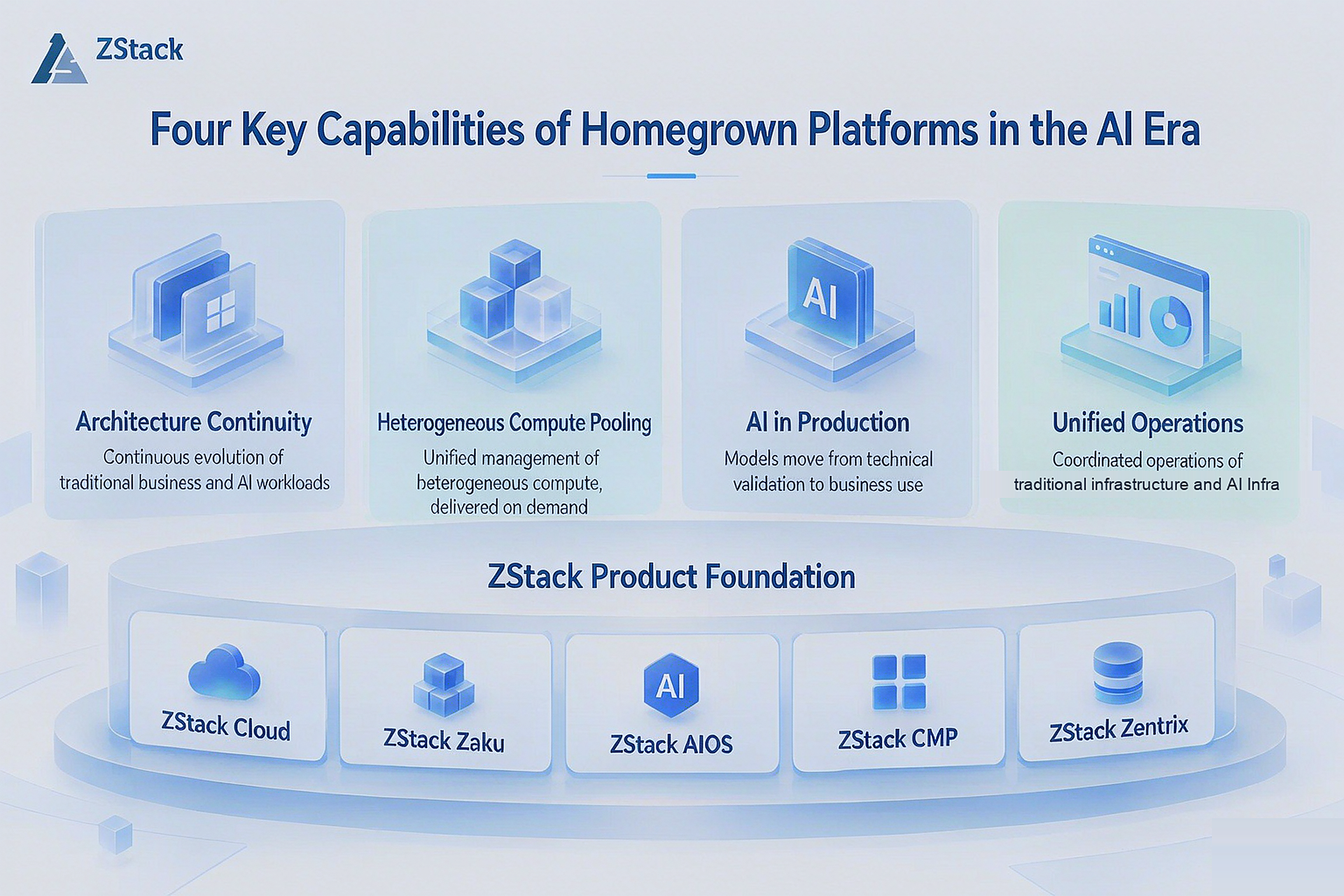
For platform selection spanning the next five to ten years, four further questions need to be answered:
1. Does the platform have sufficient architectural continuity to keep traditional business and AI workloads coexisting and evolving over the long term?
2. Does the platform have the ability to organize heterogeneous compute — uniformly managing accelerators built on different technology routes and delivering them efficiently according to task needs?
3. Does the platform have AI production capability — connecting compute, models, inference services, and business invocation to shorten the distance from technical validation to production use?
4. Does the platform's operations system have extensibility — bringing traditional infrastructure and AI Infra into a unified, sustainable operations framework?
These four questions can serve as the key dimensions for enterprises to assess the long-term value of a domestic platform.
ZStack, with Cloud and Zaku as its base carriers, connects heterogeneous compute and model services through AIOS, and links infrastructure operations with AI call governance through CMP and Zentrix — forming a continuous technology system that runs from traditional infrastructure to AI Infra and then to AI services.
Architectural Continuity: ZStack Cloud and Zaku as the Dual Engines for the AI Evolution
ZStack Cloud continues to carry an enterprise's existing business and general-purpose cloud workloads, while AIOS is built directly on top of Cloud and Zaku, carrying AI workloads through the dual engines of cloud VMs and containers:
The VM Cloud handles complex dependencies, model reproduction, fixed runtime environments, and stronger isolation requirements;
The Zaku handles rapid deployment, elastic inference, development and testing, and cloud-native AI applications.
AI workloads themselves have clearly different runtime requirements. Algorithm development, model reproduction, and certain long-running inference services typically depend on a full operating system, specific CUDA and PyTorch versions, complex toolchains, or stronger system isolation; elastic inference, development and testing, and cloud-native AI applications, by contrast, place greater emphasis on image-based delivery, rapid creation, and scaling with load.
Whether a model runs in a Cloud VM or a Zaku container, the model files, inference templates, and published services are all managed uniformly by AIOS. Enterprises can choose the underlying carrier based on dependency environment, isolation strength, and elasticity requirements, while service publication and invocation remain consistent at the upper layer.
By choosing ZStack Cloud and Zaku, enterprises gain a dual-engine foundation for AIOS at the same time. Existing cloud capabilities and future AI build-out evolve continuously along the same technology stack.
Turning Heterogeneous Compute into a Resource: From Compatibility Access to Unified Management and On-Demand Delivery
ZStack AIOS brings different GPUs into a unified resource view and delivers them differentially according to the runtime characteristics of ZStack Cloud and Zaku.
AI infrastructure adds GPUs, NPUs, and other accelerators, and different brands and models correspond to different drivers, software stacks, partitioning methods, and applicable scenarios. Beyond confirming whether a device can be integrated, enterprises must decide which task a given GPU should be delivered to, whether to use full-card or partitioned mode, how video memory is reclaimed, how multiple departments share a card, and how device status is continuously monitored.
On the Cloud VM side, the platform supports four GPU management modes:
1. GPU passthrough: a physical GPU is delivered directly to a cloud VM, suited to sustained high-load LLM inference and HPC tasks.
2. Vendor vGPU: leverages the vendor's virtualization capability to partition the GPU, suited to environments that hold the corresponding licenses and require hardware-level strong isolation.
3. MIG: uses the hardware partitioning capability of NVIDIA GPUs to create multiple isolated instances, applicable to MIG-capable models.
4. dGPU dynamic partitioning: dynamically allocates video memory and compute through software, without relying on NVIDIA vGPU licensing and without requiring MIG support on the GPU.
dGPU uses a CUDA API interception-and-forwarding mechanism to achieve software-layer resource control between a cloud VM and the physical NVIDIA GPU. Administrators can predefine multiple video-memory profiles based on GPU model and task needs — for example, matching 7B, 14B, or 32B models or Embedding services — without having to pre-slice a physical card into fixed fractions of 2, 4, or 8.
When a cloud VM starts, the platform allocates a dGPU instance of the corresponding profile from the resource pool; when the VM is shut down or removed, the occupied video memory is immediately released and returns to the pool for other tasks.
For applications inside a VM, dGPU behaves essentially the same as GPU direct passthrough. Existing software such as CUDA, PyTorch, and vLLM can run directly, and business code does not need to be rewritten for dGPU.
A single physical GPU can therefore take on algorithm development, model validation, and lightweight inference tasks of different video-memory sizes on demand, reducing the resource fragmentation caused by fixed partitioning and preventing low-load tasks from occupying an entire card over the long term.
On the Zaku container side, the platform supports both full-card GPU and video-memory partitioning. Container video-memory partitioning is as fine-grained as 1%, suitable for development and testing, Embedding, Rerank, small-model inference, and multiple lightweight tasks sharing a single card.
The platform can also uniformly view GPU model, working state, allocation relationships, utilization, video memory, and power consumption, and issue alerts on abnormal states.
Heterogeneous devices move from a hardware inventory into a resource system that can be allocated, reclaimed, and observed, enabling enterprises to choose the delivery mode that best fits their performance, isolation, licensing, and resource-granularity needs.
Compute compatibility in the AI era must extend all the way to compute delivery. ZStack AIOS turns heterogeneous GPUs into a resource pool that can be allocated by task, keeping devices of different models and profiles continuously serving real workloads.
AI Productionization: Opening the Delivery Pipeline from Compute Allocation to Business Invocation
AIOS builds a model-service layer on top of compute, organizing models, datasets, inference templates, and compute resources into a single delivery pipeline.
Once GPUs are allocated, enterprises still need to prepare model files, datasets, inference frameworks, and dependency environments, and to complete parameter tuning, service publication, runtime monitoring, and performance evaluation. When each project builds its own environment, model versions, software stacks, and deployment approaches gradually diverge, and platform delivery can stay stuck at the infrastructure layer for a long time.
AIOS converts compute into model services through the following process
1.Models enter the model repository via local upload, a URL, or the open-source community, and are isolated and shared by account and project
2.Inference templates manage frameworks and runtimes such as vLLM, SGLang, Transformers, and Diffusers
3.Users choose a Cloud VM or Zaku container based on the model's characteristics, and the platform computes the required inference resources and creates the service
4.Once a service is published, a standard API is generated, with Notebook used for parameter and environment debugging before deployment
5.The platform continuously provides request logs, load monitoring, elastic scheduling, sub-second self-recovery after failures, and multi-level caching of model files.
AIOS also provides model-capability evaluation and inference-performance evaluation. Enterprises can use standard or custom datasets to check model effectiveness and assess service performance through concurrent stress testing, providing a basis for model selection, GPU-specification comparison, capacity planning, and production go-live.
This pipeline also precipitates the environment-preparation work that recurs throughout projects into reusable assets. Once model files and datasets enter the repository, they can be shared across the inference, fine-tuning, and evaluation tasks within the same account or project, reducing duplicate storage; validated inference frameworks, dependencies, and parameters can be fixed into templates, so follow-on teams no longer need to reassemble runtime environments.
After a model service is published as an OpenAI-compatible API, the application side can integrate through a relatively stable invocation method, reducing — within the bounds of API compatibility — the impact of underlying model or carrier-engine changes on business systems.
ZStack Cloud and Zaku ultimately output consistent model APIs. The underlying engine can be adjusted according to the task stage, while business applications continue to call models through stable interfaces, and changes in the compute environment are contained within the platform.
ZStack extends the platform's delivery target from cloud VMs and containers to model services. After standardized deployment, runtime assurance, and evaluation, compute resources can go directly into enterprise applications.
Unified Operations: Bringing Traditional Infrastructure and AI Infra into One System
ZStack brings traditional infrastructure and AI Infra into a single operations framework, forming interlinked operations layers according to the objects being managed:
ZStack CMP is responsible for infrastructure operations, bringing Cloud, Zaku, and the GPUs they use into organization, permission, quota, application, and approval processes, while also uniformly operating and managing heterogeneous cloud platforms from other vendors
ZStack AIOS is responsible for lifecycle management of models, datasets, inference templates, and model services
ZStack Zentrix, as an enterprise-grade AI gateway, is responsible for AI capability integration and call governance, managing access credentials, permissions and quotas, routing policies, usage metering, and full-chain auditing
The build-out of AI Infra spans heterogeneous accelerators, cloud VM and container runtime environments, models and datasets, inference services, and their invocation process. As AI expands from a single project to multiple departments, these new objects need to follow the same organization, permission, quota, and cost framework as servers, storage, networking, and traditional cloud resources.
Each layer is professionally managed by its corresponding product, while preserving the operational linkage between infrastructure provisioning, model-service delivery, and AI consumption.
Business departments can continue to request the compute they need through the enterprise cloud portal; the platform team publishes model services in AIOS; and applications access — uniformly through Zentrix — model services provided by AIOS or by third-party AI infrastructure.
Managers can separately track the infrastructure resources each department has received and the model invocations actually generated, and adjust resource quotas, model channels, and cost-allocation strategies accordingly.
As enterprises add models and AI applications, the original cloud operations system continues to function, and the new AI service governance can expand along the same unified organization and cost relationships.
ZStack Cloud and Zaku provide the runtime environment, AIOS delivers model services, and CMP and Zentrix handle infrastructure operations and AI call governance, respectively. ZStack takes AI from technical experimentation into sustainable operations.
On-the-Ground Practice: From a Department-Level AI Platform to a Thousand-GPU Smart Computing Center
A Provincial University of Finance and Economics: Building a Multi-Department AI Compute Base by Repurposing Existing Assets
The university already had servers, storage, eight NVIDIA A40s, and eight NVIDIA L20s. Different research groups and departments had varying requirements for performance, isolation, and resource granularity, while also needing continuous visibility into GPU status and load, and the ability to provide model capabilities to campus applications.
ZStack brought the existing hardware and the two GPU types into the AIOS compute resource pool uniformly, providing GPU passthrough, vGPU, and video-memory partitioning according to task, and tracking device status and load through unified monitoring. On this foundation, AIOS completed the deployment of large language models and multimodal models, connecting administrative, teaching, and research applications through standard inference APIs.
The platform now carries multiple types of business — including on-campus AI services, intelligent Q&A, sports digital-management, and discipline-specific large models — and the original infrastructure has been transformed from scattered resources into AI capabilities that can be delivered continuously.
A Provincial-Level Smart Computing Center: Unifying Multiple Compute Forms at Thousand-GPU Scale
This project targets the construction of a provincial government smart computing center and needs to manage more than 2,000 GPUs across multiple compute clusters. The center contains devices from different vendors, such as NVIDIA and AMD, at the same time.
Business tasks must run in both containers and VMs, and some require elastic bare metal; some tasks need full-card performance, while others need vGPU or video-memory partitioning. As device models, runtime environments, and delivery methods all increase at once, cross-cluster scheduling, resource status monitoring, and unified operations become critical to the project.
The ZStack solution uniformly manages NVIDIA, AMD, and other GPUs, carrying different workloads through containers, VMs, and elastic bare metal; on the delivery side, it provides GPU passthrough, vGPU, and fine-grained container video-memory partitioning, while centrally presenting device status and usage on the operations side.
The smart computing center can thus schedule resources according to each task's performance, isolation, and elasticity requirements, and complete continuous management of large-scale heterogeneous compute in a unified view.
When AI build-out expands from a departmental pilot to a regional smart computing center, the managed objects grow from a dozen or so GPUs to thousand-GPU clusters, and the computing environment shifts from a single form to coexisting cloud VMs, containers, and bare metal.
Relying on a unified technology stack, enterprises can preserve architectural and operational continuity as resource scale and the scope of use expand, so that the resource pooling, service delivery, and management systems formed early on continue to absorb new hardware, models, and using departments.
In the AI Era, the Selection Criteria for the New Cloud Management Platforms Are Being Redefined
Compatibility remains the foundational capability of a platform. It ensures that processors, operating systems, servers, storage, and business applications run reliably, and it determines whether a project can get off the ground smoothly.
In the AI era, however, a platform must further prove its ability to absorb change: workloads will diverge between cloud VMs and containers; compute roadmaps will keep evolving alongside domestic GPUs, NPUs, and model ecosystems; the platform's delivery target will extend from infrastructure resources to model APIs; and the scope of use will expand from a small number of technical staff to multiple business departments.
ZStack, through Cloud, Zaku, AIOS, CMP, and Zentrix, forms a continuous product system built for AI-Ready: it is compatible with the multi-kind software and hardware ecosystem, carries diverse workloads, organizes heterogeneous compute, delivers model services, and brings traditional infrastructure and AI Infra into coordinated operations.
The platform an enterprise chooses today is also determining how far its future AI build-out will need to go.