Governing access when agents call internal tools
Connect enterprise agent identity to MCP tool permissions and auditable requests.

Agents are entering the enterprise faster, and identity and permission governance must keep pace.
On September 30, 2026, Gartner published *Agentic Security: Secure AI Agents With Workload IAM Architecture*, noting that the rapid expansion of agents inside enterprises has made it hard for most organizations' existing identity and access management (IAM) capabilities to keep up.
According to a survey cited in the report, 42% of respondent organizations have not yet established a formal machine identity and access management strategy.
hen an agent can call tools, access business systems, and perform actions, the permissions an enterprise grants it become a real business risk. Who an agent acts on behalf of, what it can access, when its permissions are revoked, and how its actions are traced — all of this must be clarified before it is connected to the business.
For enterprises moving forward with agent adoption, this research report offers a clear governance direction:
Big agents under workload IAM, so that identity, credentials, and authorization controls enter the actual invocation process.
01 / Agent Access Risks
Hand business capabilities to agents, and hand over clear access boundaries along with them.
The report points out that some security teams still manage agents as if they were human accounts, or allow employees to share credentials with agents. At the same time, 47% of respondent organizations still use broad IAM policies that cover both human and machine identities. Such practices make it easy for agents to gain permissions beyond what their tasks require.
When employees and agents share credentials, responsibility in access records can become mixed; long-lived credentials scattered across different configurations may continue to grant access even after a task is finished.
If an agent is taken over by an attacker, or performs operations beyond what was intended, an overly broad permission scope can amplify the impact of data leakage, configuration changes, and data deletion.
To control these risks, enterprises need to make clear — at the moment an agent accesses a system — the identity it uses, the resources it is permitted to access, and the operations it is allowed to perform, and to adjust access when a task ends or permissions change.
As the number of agents grows, these requirements must also be enforced continuously through a unified management system.
02 / Gartner IAM Guidance
Gartner's advice: centralize governance, and enforce controls at the point of agent access.
1. Define the object of management clearly, and bring agents under workload IAM
Gartner recommends first classifying agents explicitly as workloads within the IAM taxonomy. This category also includes virtual machines and containers, and belongs to the scope of machine identity management.
Enterprises can reuse existing workload management tools, standards, and control mechanisms to build the foundation for agent identity and access management.
Once classified, governance gains concrete anchors: reduce the distribution of long-lived credentials by using short-lived credentials, limit access scope under the principle of least privilege, associate autonomous operations with the agent that performs them, and revoke access when needed.
When an agent acts on behalf of an employee, it is also necessary to distinguish the agent's own identity from the permissions delegated by the employee, so that sharing a human account does not become the default way of connecting.
Different types of agents, however, run in different environments and under different control conditions. Platform-native agents, SaaS-embedded agents, and endpoint-native personal agents each require separately identifying the IAM control needs on the management side and at runtime.
Enterprises should first determine which types of agents need governance, then assess the coverage of their tools, so that control methods fit the actual connection conditions.
2. Build a governance architecture that connects identity, access, and authorization
On this basis, Gartner divides the controls in a workload IAM architecture into three categories. Enterprises need to clarify the responsibilities of each, and make the different categories work together when an agent accesses a system.
Workload identity management — responsible for identity discovery, registration, inventory maintenance, and governance, helping enterprises see the agents and their associated credentials across environments. This capability can also integrate with code repositories, IT service management systems, and collaboration tools, providing cross-environment visibility for identity governance.
Workload access management — responsible for runtime identity and access control. It combines workload identity providers, key management, public key infrastructure (PKI), and identity issuance, allowing agents to access systems using appropriate identities and credentials.
Authorization management platform— responsible for runtime dynamic authorization, as well as the centralized authoring, versioning, transformation, and orchestration of policies, applying fine-grained control to infrastructure, applications, and data.
Once these three categories of controls are connected, enterprises can answer: what agent identities exist, how they obtain access, and which operations specific accesses are permitted to perform.
The identity inventory provides the basis for management, the access mechanism carries the identity into the system, and the authorization policy further constrains the scope of operations.
The overall architecture Gartner proposes is:
A unified workload identity management system and an authorization management platform supporting multiple access management components across on-premises, hybrid cloud, and multi-cloud environments. Governance and policies are managed centrally, while identity issuance and access control are executed in their respective environments. Enterprises can unify management requirements while preserving the ability of each security domain to adapt to local access conditions.
Therefore, when selecting tools, attention should be paid to how they connect: how identity information enters the access process, who manages policies and where they are executed, and how systems collaborate.
Complete governance requires multiple types of tools working together.
3. Build step by step, and first control existing access risks
This architecture requires continuous construction. The implementation sequence Gartner gives allows enterprises to adjust based on their own foundation — first addressing existing risks, then progressively improving centralized governance.
Step one: complete access control across environments.
Those responsible for on-premises, cloud, hybrid, and regional environments implement workload access management practices, prioritizing agents that are already in use but lack proper IAM controls, to reduce the access exposure currently present
Step two: establish centralized identity management capabilities.
Discover and register agents that have not yet been brought under management, and begin centrally governing the access management components already deployed across environments, so that scattered connections gradually gain an organization-level management basis.
Step three: introduce a centralized authorization management platform.
Integrate with access management tools and other components to extend policies and fine-grained control to infrastructure, applications, and data, so that unified management requirements are enforced during access processes across different systems.
During construction, enterprises also need to identify existing technical debt, invest progressively according to risk and business needs, and have IAM teams participate in agent projects across business departments. The team's accumulated experience with hybrid cloud, multi-cloud, and cross-system scenarios can help business connection and access governance advance in parallel.
The report also mentions a specific connection path:
Use workload identities to support agents acting on behalf of employees, carry over user permissions through secure temporary tokens, and route agent access requests through an AI-facing gateway that enforces centralized security controls and protects existing credentials.
This suggestion gives teams that are opening up enterprise tools and business systems a starting point: bring agent business invocations into a manageable entry point, so that permission requirements take effect together with each invocation.
03 / Zentrix Access Governance
ZStack Zentrix: let enterprises open up business capabilities while staying in control of agent access.
Enterprises connect agents to business systems so they can accomplish more valuable work. As the scope of connections expands, platform teams also need to continuously grasp which services are exposed, where credentials are used, which requests can be executed, and when access is revoked.
The ZStack Zentrix enterprise AI gateway ties these management actions into the same governed invocation path:
Administrators open approved business services, agents initiate access through the gateway, the platform performs admission checks before invocation, and the execution side then uses managed credentials to access upstream systems, while retaining relevant governance records.
Enterprises can bring scattered connections into an entry point they control, gradually forming a management approach in which business capabilities can be distributed, access can be controlled, connection permissions can be revoked, and related operations can be audited.
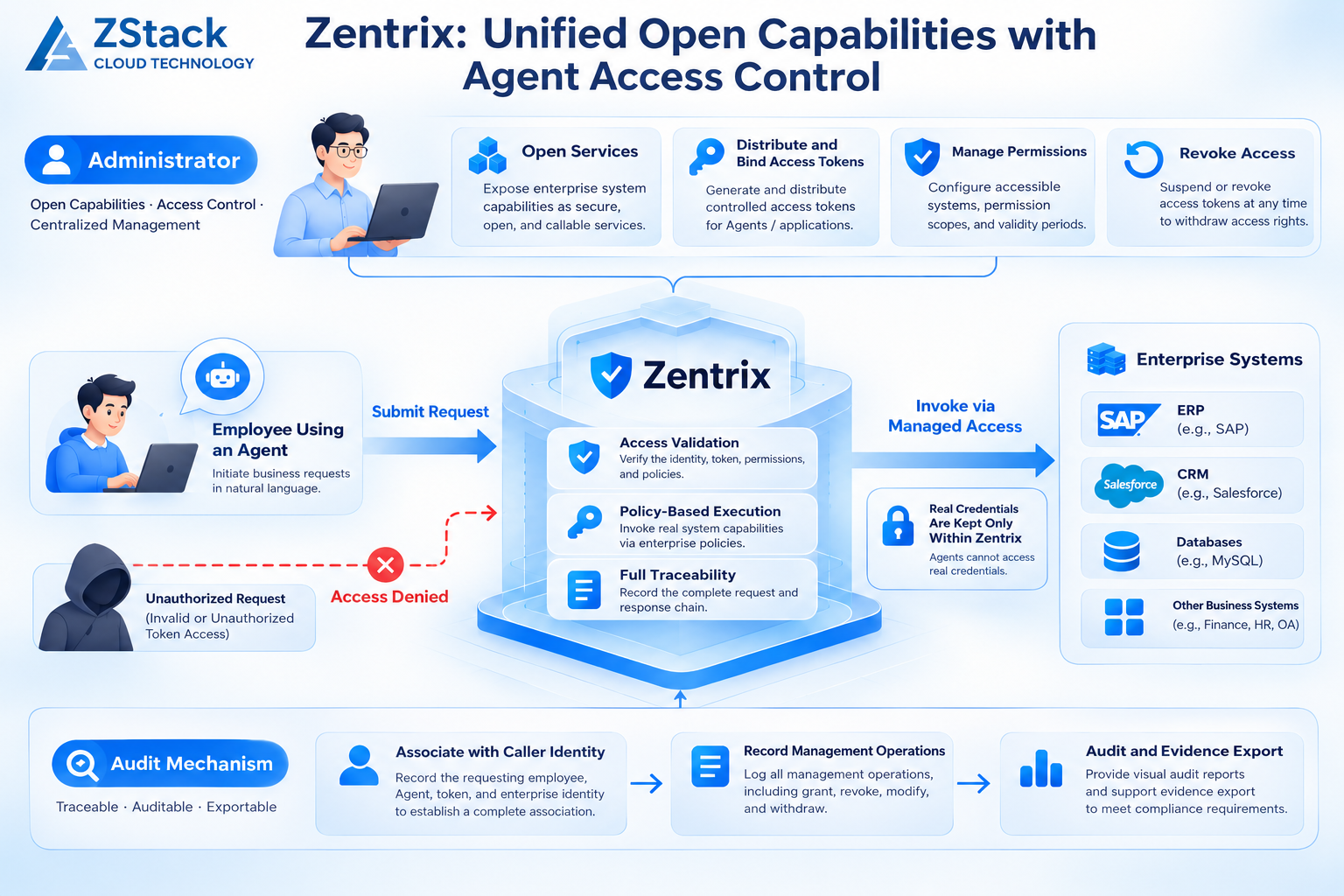
1. Enterprises open services uniformly, agents use capabilities, and real credentials stay on the execution side
When opening business capabilities, if each agent is configured with its own upstream account and keys, the more connections there are, the more easily credentials become scattered, and the more dispersed subsequent maintenance becomes.
Zentrix supports exporting already-connected governed MCP services as connection configurations and issuing corresponding access tokens. Agent applications that support MCP use this configuration to connect to enterprise-provided services, while administrators manage access on the platform.
When actually accessing upstream systems, business credentials are decrypted and used by the execution side based on a verified credential lease — they are not returned to the agent application, nor read from its invocation requests.
Enterprises can open approved services to different agent applications, reducing the need to copy upstream accounts and keys one by one into each application's configuration.
Employees gain callable business capabilities, while platform teams hold the entry point for service exposure and credential use.
The "protect existing credentials and enforce controls centrally" that Gartner proposes finds a concrete mechanism in this connection path.
Existing agent applications can start from governed MCP connections to fill in access management, while the validity periods and permission scopes of credentials in business systems continue to be managed according to the corresponding rules.
2. Maintain continuous control after opening, so access adjusts with business needs
After services are opened to agents, enterprises need to ensure that management requirements continuously constrain actual invocations.
Before a governed MCP request reaches the upstream system, Zentrix verifies the access token, checks tenant and workspace visibility, and checks tenant-level routing admission.
Only requests that pass these checks proceed to the execution side; when a token is invalid, access is unauthorized, or routing is closed, the request is rejected at the admission stage.
The platform uses a relational authorization service to determine permission relationships between subjects and resources; in the server deployment model, when the relevant authorization service is unreachable, permission checks remain in a deny state.
When access changes, administrators can list and revoke the MCP access tokens issued by the platform, and both issuance and revocation operations are recorded.
Service opening, invocation admission, and access revocation can be completed within the same management process, reducing the need for enterprises to enter each agent application separately to maintain connection configurations.
This management approach extends "who services are opened to" to "whether the current request can be executed," while also retaining the means to revoke the corresponding access.
Enterprises can adjust the access entry point as business needs evolve, while data scope, field, and object permissions inside business systems continue to be enforced by the corresponding authorization mechanisms.
3. Build connection and auditing together, so management actions are verifiable
Once the access entry is centralized, enterprises also gain a clear path for organizational auditing: from service connection and token changes to related operations, confirming the source of responsibility and the scope of records layer by layer.
Zentrix's execution side supports signing and encrypting the caller identity header, enabled according to deployment requirements and coordinated with the receiving and verification methods of downstream interfaces, bringing the real caller identity into the governed invocation.
When an agent works on behalf of an employee, this mechanism helps preserve the delegation source, allowing operation auditing to be associated with the actual initiator.
The platform provides write-operation auditing and evidence export, supports tamper detection after the fact through append-only constraints and a hash chain, and the export action itself is also recorded.
Enterprises can combine upstream business records to audit access changes and related operations, providing a basis for internal audit and accountability.
In this way, when platform teams open new services, they can simultaneously design identity propagation, authorization hand-off, and record auditing.
As more agents connect, the existing governance path can accommodate new services, reducing the need to design connection and auditing processes separately for each project.
04 / Start With Business Access
Let agents reach the business faster, and let enterprises keep control of the access boundary.
Gartner has laid out a long-term governance direction, and enterprises can start from the business access that most needs control right now.
For teams that already use multiple agents and are opening up internal business capabilities, Zentrix provides a practical path:
Keep the agent applications that support MCP, bring service opening, credential use, invocation admission, and access revocation under the enterprise-controlled gateway entry point, and collaborate with existing IAM and business systems.
Enterprises can first choose one MCP business chain to verify service distribution, unauthorized-access denial, access-token revocation, and record auditing, then expand coverage according to business needs. As agents gain more usable capabilities, enterprises still hold the initiative in service opening and access management.
Welcome to contact ZStack to schedule a Zentrix product briefing and demo, and plan your connection approach based on your existing agents and business systems.